



In the summer prior to his thirtieth birthday, the Austrian-Jewish writer Joseph Roth changed trains at a railway junction just south of the centre of Berlin. The station was called Gleisdreieck and it made a powerful impression on Roth’s imagination. “I must declare that I am quite taken by Gleisdreieck,” he wrote in a feuilleton piece published in the Frankfurter Zeitung in late July that year.
For Joseph Roth, Gleisdreieck was more than merely a railway junction. It was a pivot of the metropolis, a place with metaphysical qualities that captured the essence of a new modernity. The name of the railway station was as intriguing to Joseph Roth as it is today to passengers who change trains at Gleisdreieck. For its name does not refer to the area of Berlin in which the station is located. It is inspired instead by the railway itself.
From: Joseph Roth’s ‘Bekenntnis zum Gleisdreieck’ (1924)Dürfen die kleinen Herzschläge noch vernehmbar bleiben, wo der dröhnende einer Welt betäubt? — Can little heartbeats still be heard where the big booming one of the world deafens us?
Gleisdreieck means ‘triangular railway junction’, a prosaic station name to be sure, and a confusing one in 2013, for nowadays it is not triangular at all but a place where two metro routes cross at right angles. Both lines are indecisive about this encounter, twisting and turning through sharp angles as they approach Gleisdreieck, creating a trajectory that surely prompts many passengers to wonder in quite which direction they might now be heading. Along the way there are fractured views of houses and parkland, abandoned railway sidings and warehouses. At the station itself, both routes are elevated far above the ground and from the platforms there are fine views over the Berlin cityscape.
Joseph Roth’s affirming credo in favour of Gleisdreieck has slipped below the literary horizon in recent years, although a brave English translation by Michael Hofmann of Roth’s original article is included in the 2003 collection What I Saw: Reports from Berlin 1920–1933 (Granta Books). Brave because this particular article by Joseph Roth is written in a lyrical and complex style, full of allusions that defy easy translation.
Roth’s Berlin, even in those Weimar years, was a dreary place — not at all like the self-indulgently gay city depicted by Christopher Isherwood. Yet at Gleisdreieck, Roth laces his habitual melancholia with a vein of optimism. This preserve of technology and machines might be a most unnatural corner of Berlin, yet it has an elemental nature of its own. Here there are no meadows and woodlands, no glades or growing crops. Instead there is just the rhythm of machines and men who are enslaved to those mechanical rhythms.
Roth’s essay takes us back to the Gleisdreieck of 1924. The two elevated urban rail routes traversed a mighty sea of other railway lines which covered the terrain below. There were sidings and shunting yards, but also the main railway lines used by trains leaving Berlin’s Anhalter Bahnhof. These tracks thus carried trains bound for the furthest ends of Germany and even beyond. From the vantage point of the platforms at Gleisdreieck, one could watch trains heading out of Berlin to Tetschen, Karlsbad, Leipzig and Vienna. For a spell, when Germany launched its own rival to the Orient Express, the so-called Balkanzug from Berlin to Constantinople, it traversed the complex of tracks under Gleisdreieck station.
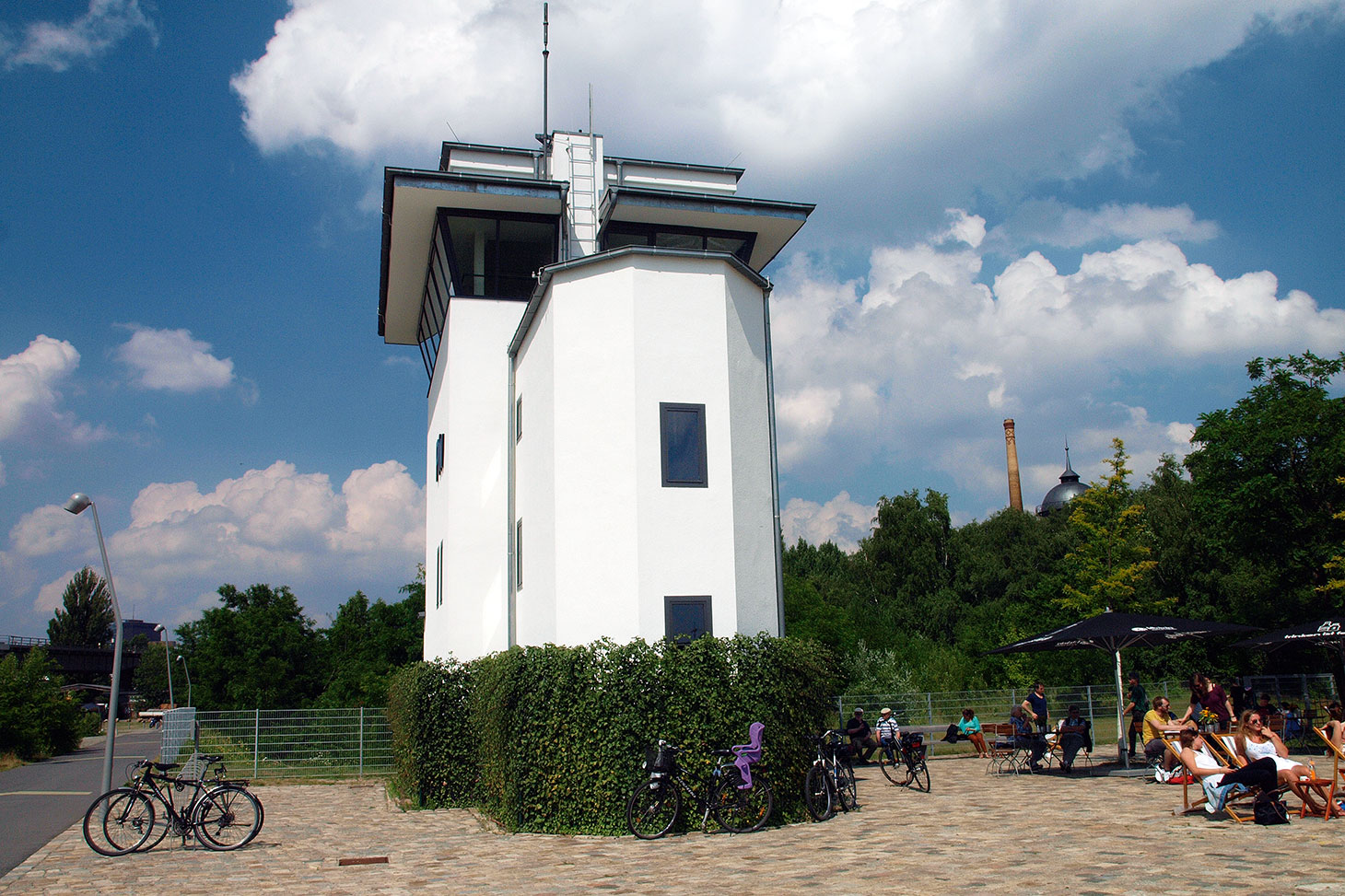
An old signal box at Gleisdreieck, now a café with woodland beyond reclaiming old railway land. The domed building in the woods is a former water tower (photo © hidden europe).
Here was something more than a railway junction. It was a portal to the whole world, and — so great was the density of traffic — that it seemed like the nerve centre of the entire planet. The proximity of the Landwehrkanal, just a hundred metres from Gleisdreieck, meant that goods could be transferred here from boats to trains and vice versa. The canal had been widened in 1845 and the freight docks by the canal were busy day and night.
If Gleisdreieck was a topos full of opportunity, a place that signalled escape from Berlin, it also had a darker side. No other junction in or around Berlin had such a legacy of disaster — and Joseph Roth surely knew this. It was a place where trains crashed, in 1908 with terrible consequences as 18 passengers lost their lives and many more were horribly injured. That accident and others in the years thereafter led to improved signalling, so Joseph Roth’s account of the junction’s soundscape — with its constant rattle of levels and clicking of signals — was affirmative and reassuring. Here was a place where man might be subdued by vast acres of technology, but now he was at least safe. In the article, Roth concludes with a reflection on the relentless power of evolution. Cities have a life of their own, and perhaps Gleisdreieck was a window into the future: a sort of urban dystopia (of the kind that just three years later was captured in Fritz Lang’s film Metropolis).
Then and now
Fast forward 89 years since Joseph Roth stood on the platforms of Gleisdreieck, and this is today still one of Berlin’s most fascinating railway stations to visit. Few who change trains at Gleisdreieck nowadays take time to survey the surrounding cityscape, and surely very few have ever heard of, still less read, Joseph Roth’s 1924 article. “Straight upstairs to change to the other line,” said a helpful man on the platform as we hopped off the U2 one afternoon earlier this month. He was very surprised when we said we wanted to linger — and linger one should, if only to reflect on the extraordinary capacity of nature to reclaim and regenerate old industrial landscapes.
The great spread of land below the platforms at Gleisdreieck (and particularly to the south of the station) is being transformed. A few warehouses and areas of derelict wasteland remain — nowadays probably the preserve of thieves and cats. Many of the railway tracks have been removed, replaced now by grassland and children’s play areas. The sidings (“whose end no human eye can see,” as Roth reminded us) are being reclaimed by nature. A dense swathe of birch, sycamore and hazel now reaches skyward, roots and branches slowly suffocating the kingdom where once the railway reigned supreme.
For Joseph Roth, Gleisdreieck was more than merely a railway junction. It was a pivot of the metropolis, a place with metaphysical qualities that captured the essence of a new modernity.
A railway signal box, refurbished and painted white, is oddly stranded in territory now given over to recreation. Where once the wheels of heavy freight wagons screeched on the tracks as trains were marshalled into formation, now there are the riders of BMX bikes inviting admiration and apprehension as their wheels defy gravity. Signals and points are eclipsed by the vocabulary of freestyle stunts. This is the kingdom of dirt and vert.
Nearby, a large area of old sleeper ballast, rough and difficult to cross, is being colonised by mosses and lichens. A number of young crab apple trees poke up through gaps in the stones. A bold starling pecks at the stones, every now and again looking up and imitating the call of other birds that nest in bushes covering old railway tracks.
The landscape of iron described by Joseph Roth has been transformed into something altogether greener. Joseph Roth’s 1924 essay is unsettling in its ambiguity — Roth is intrigued by what he sees; he asserts very firmly that it is interesting, but we never quite discover whether he likes it or cannot abide the place. Visiting Gleisdreieck 89 years after Roth, we can be more decisive. It is a little pivot of heaven in the heart of the busy city. Once this was a territory reserved for noisy machines. Now it is a place for small heartbeats too.

